Before we even get to describing our trip, it’s worth mentioning its rather unconventional start!
This journey was special in one particular way. That same week in July, we had actually been in Croatia, on the island of Mali Lošinj, together with our parents.


On 27th July – the day we were still in Croatia but returning home that evening – things were actually rather out of the ordinary.
When we set off from the island, we already had just a few hours left before our flight from Bratislava, Slovakia to London!
Later that evening, on our way to Bratislava, we came across a petrol station that looked exactly like the one from Cars! (Complete with a vintage Volkswagen camper van parked outside!)


You can read more about our trip to Croatia in the previous post, so now I’ll move on to the English adventure!
We arrived at the airport a little before four in the morning, with our flight scheduled for six.

The flight itself was smooth and calm, the kind where time seems to slip by almost unnoticed. Peter, in a rare twist of fate, even managed to drift off into a peaceful nap – something he never usually does on planes. When we touched down at Stansted, it felt like greeting an old friend.
I had been looking forward to this next bit for weeks: the train ride from Stansted to Liverpool Street Station. There’s something almost magical about slipping into carriage from the airport just after sunrise, the air still cool from the night, and watching the world awaken through the wide windows.
As the train glided forward, the scenery began to shift. First the open stretches of countryside, then the outskirts of the city, and finally the embrace of London itself. Buildings on the outskirts had a distinctly London look. Uniform red and brown brickwork, tall rectangular chimneys. It was a clear reminder of how London layers its history. The utilitarian post-war housing estates sitting just a few streets away from contemporary developments.

And at last, we were greeted by that familiar London cityscape — a mix of charming brick buildings and modern skyscrapers. We grabbed a breakfast meal from McDonald’s and took it down to a bench right by the Thames, with Tower Bridge. Sitting there in the cool morning air, we ate while watching London’s early risers jogging along the riverside, the city slowly coming to life around them.

What followed was a wander through all sorts of streets across the city. For a while, we were puzzled by how strangely quiet everything felt. And then it clicked – it was Sunday, and only eight o’clock in the morning!
I personally enjoy most about the London the little parks and side streets you stumble upon by chance while making your way between the landmarks.

We were already feeling the weight of the early start, having been up since before 4 a.m. to catch our flight, so we decided to head to our accommodation and have an afternoon nap. That nap turned out to be rather long, and we woke up to the beginnings of a London evening. Without wasting any time, we set off back into the city!


We remembered some really good noodles we’d had near Big Ben on a previous trip, years ago. We decided to check if they were still there and, to our surprise, they were! There was no way we could pass up the chance to enjoy them again.

And as the sun began to set, the city took on an entirely different atmosphere. The light softened into a warm golden hue. Glass windows caught the glow and reflected it back in shimmering flashes, while narrow streets became partly hidden in cool shade. The contrast between the bright, sunlit rooftops and the deepening shadows below gave the streets a calm, almost cinematic quality.


we took a stroll through Covent Garden, where we stopped to listen to, and even sing along with, an incredible street musician whose performance filled the place with energy. From there, we made our way to the bright lights of Piccadilly Circus, soaking in the lively atmosphere and buzzing crowds. But knowing we needed to be well-rested for the next day’s journey, we eventually headed back and called it a night.
D Day – Seven Sisters
We woke to a bright, sunny morning and headed straight to Victoria Station, where a Southern Railways train would take us directly to England’s south coast. About an hour later, we arrived in Seaford — a small town of roughly 25,000 residents.
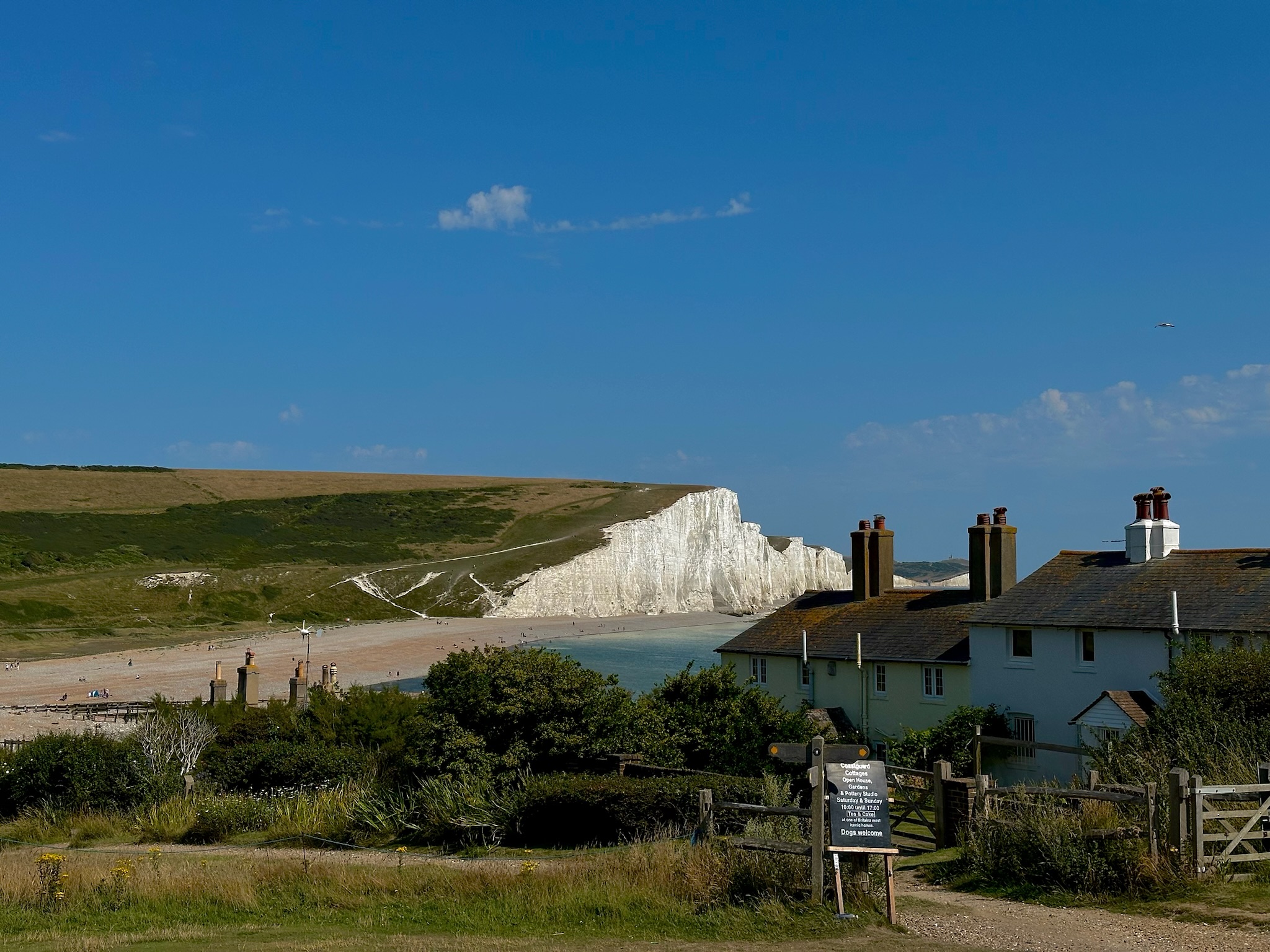
In town, we admired the local library, a small park with a pond, and, before long, the real reason we had come here, the famous white cliffs.

We stopped for an excellent pizza, though Peter began to look a little uneasy. My plan for the day was to walk the entire Seven Sisters route, from Seaford all the way to Eastbourne, where we’d be staying that night.

In front of us lay a good 17 kilometres of walking – something I hadn’t really grasped at the time, happily sitting in Seaford, listening to the sound of the sea, the cries of seagulls, and the gentle coastal breeze.

Our trek had officially begun! And right from the start, we were met with some pretty steep climbs. But before diving into the walk itself, it’s worth pausing to explain exactly where we had arrived.
The Seven Sisters are an iconic series of chalk cliffs on the south coast of England, stretching along the shoreline between Seaford and Eastbourne in the South Downs National Park. Formed millions of years ago from the compressed remains of marine organisms, these white cliffs are continuously shaped by coastal erosion, giving them their striking, ever-changing appearance.


The name Seven Sisters was coined by locals, poetically referring to the seven prominent chalk peaks and valleys along the coast, which resemble “sister” hills standing side by side. Over the centuries, the cliffs became an important landmark for sailors navigating the treacherous waters of the English Channel – their brilliant white faces visible from many miles away, acting as a natural daytime beacon.
During the Second World War, the Seven Sisters played a strategic role in Britain’s defence. The cliff tops were home to defensive posts, radar stations, and barricades designed to repel a possible Nazi invasion. Parts of the area were even mined, and to this day you can still spot remnants of bunkers and fortifications, silent witnesses to one of the most dramatic chapters in British history.
